
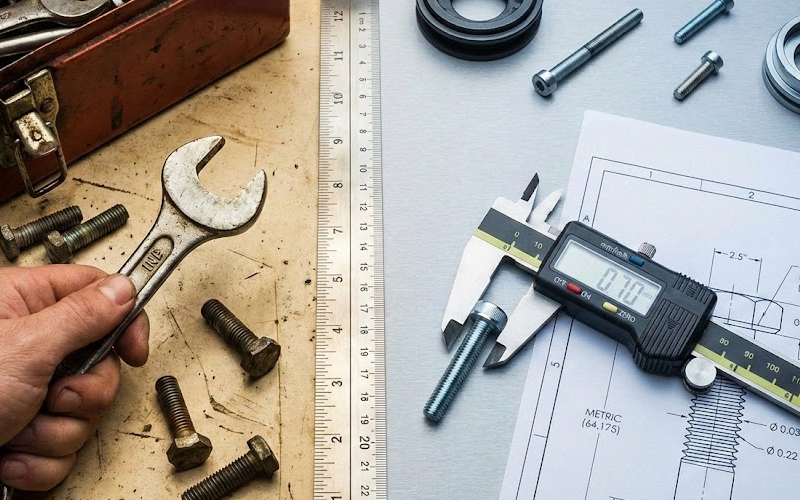
For decades, U.S. manufacturing ran almost exclusively on the Imperial (inch) system. But as more companies began exporting and competing globally, the need for metric fasteners grew—and many engineers quickly realized that metric isn’t just a global standard. In many ways, it’s the better engineering system.
Why Metric Fasteners Make More Sense for Modern Engineering
Thirty years ago, metric fasteners were considered niche in the U.S. Today, they’re quickly becoming the default. The shift didn’t happen by accident—metric simply provides a clearer, more consistent framework.
1. Logical, Consistent Strength Classes
Metric property classes (like 8.8, 10.9, and 12.9) follow a simple and intuitive system based on tensile strength. Imperial grades, by contrast, tend to be more fragmented and confusing.
For engineers, metric removes guesswork.
2. Cleaner, More Practical Sizing
Metric sizes scale predictably. Once you learn them, the system feels much more natural than juggling fractional-inch measurements.
Engineers who make the switch often say the same thing: “Once you figure it out, you’ll never want to go back.”
Where Metric Has Major Advantages
Flange Bolts
In the U.S., inch-series flange bolts are surprisingly rare. Teams often end up using a hex bolt plus a separate washer. Two components instead of one.
In metric? Flange bolts are widely available, standardized, and cost-effective.
Hardened Washers
In the inch system, hardened washer availability and specifications can feel “a little goofy,” as our expert puts it. Metric washers, on the other hand, are tightly defined with clear classes and consistent performance expectations.
Torx Drive Screws
Torx has become the preferred drive style for smaller screws because it reduces cam-out and improves assembly accuracy. In the inch system, Torx options are limited. In metric, Torx is standard and widely available across sizes.
Thread Pitch That Just Makes Sense
Imperial fasteners have coarse and fine threads—and both get used heavily depending on the application.
Metric threads? Their standard pitch falls almost exactly between coarse and fine inch threads, giving you the strength and versatility of both without needing multiple thread families.
So… Why Isn’t Everyone Already Using Metric?
Because transitioning isn't easy—especially midstream.
If a company tries to switch “on the fly,” it can slow down production or cause confusing crossover between the two systems. That’s why we recommend introducing metric during:
- A new product development cycle
- A redesign or engineering update
- A manufacturing transition or consolidation
New projects provide a clean slate, avoiding the chaos of mixing metric and inch hardware in the same assembly.
Making the Transition: Easier Than You Think With the Right Tools
The biggest barrier to switching is simply figuring out the equivalent metric part. But the conversion itself? Surprisingly straightforward.
Our converter makes it even easier to convert imperial to metric:
- Select your inch fastener
- Input grade and dimensions
- Get the closest metric equivalent
Metric ↔ inch fasteners converter
These tools remove the fear factor and speed up the transition dramatically.
Thinking about transitioning your next project from imperial to metric?
We can help simplify the process—and set your team up for long-term success.